Boise had a street car system in 1890. They were built in many cities in the latter part of the 19th century as an efficient way to get people around town. Boise’s system soon became Treasure Valley’s system, with lines going in a 60-mile loop to Eagle, Star, Middleton, Caldwell, Nampa, Meridian and back to Boise.
It was popular for people to pack a picnic lunch and take the loop on a Sunday just for the fun of it. Spurs were extended from Caldwell to Wilder and Lake Lowell, as well.
Several companies ran portions of the system, which become generally known as the Interurban, over the years. The light rail trains were powered by electricity, so it shouldn’t come as a big surprise that Idaho Power Company ran the trains for a time.
Wouldn’t something like that be a wonderful resource today? So why weren’t “we” smart enough to save the Interurban?
First, you need to know that it wasn’t a public system. Several companies were involved over the years, each trying to make a profit, and none really succeeding. Yes, there’s a conspiracy theory that General Motors bought up all the light rail lines in the country and closed them down so that people would have to buy cars. And, yes, GM was convicted for plotting to monopolize transportation systems post World War One. But it wasn’t GM that killed the systems. Not exactly. They were trying to make a profit from their National City Lines (which did NOT run a system in the Treasure Valley).
Cars did help kill the trollies when people began buying them. But it was buses that proved their demise. It was simply much cheaper to add a bus route and a few bus stop signs as cities grew. Quicker, too. Interurban tracks were taken out in some places as buses and cars became the dominant forms of transportation. Often they didn’t even bother pulling up the tracks, instead they just paved over them like the useless relics they had become.
Ah, but, wouldn’t it be nice to hop on a smooth running trolley and watch the cities and sagebrush go by while you enjoyed an ice cream cone on a Sunday afternoon?
#interurban #boiseinterurban
It was popular for people to pack a picnic lunch and take the loop on a Sunday just for the fun of it. Spurs were extended from Caldwell to Wilder and Lake Lowell, as well.
Several companies ran portions of the system, which become generally known as the Interurban, over the years. The light rail trains were powered by electricity, so it shouldn’t come as a big surprise that Idaho Power Company ran the trains for a time.
Wouldn’t something like that be a wonderful resource today? So why weren’t “we” smart enough to save the Interurban?
First, you need to know that it wasn’t a public system. Several companies were involved over the years, each trying to make a profit, and none really succeeding. Yes, there’s a conspiracy theory that General Motors bought up all the light rail lines in the country and closed them down so that people would have to buy cars. And, yes, GM was convicted for plotting to monopolize transportation systems post World War One. But it wasn’t GM that killed the systems. Not exactly. They were trying to make a profit from their National City Lines (which did NOT run a system in the Treasure Valley).
Cars did help kill the trollies when people began buying them. But it was buses that proved their demise. It was simply much cheaper to add a bus route and a few bus stop signs as cities grew. Quicker, too. Interurban tracks were taken out in some places as buses and cars became the dominant forms of transportation. Often they didn’t even bother pulling up the tracks, instead they just paved over them like the useless relics they had become.
Ah, but, wouldn’t it be nice to hop on a smooth running trolley and watch the cities and sagebrush go by while you enjoyed an ice cream cone on a Sunday afternoon?
#interurban #boiseinterurban
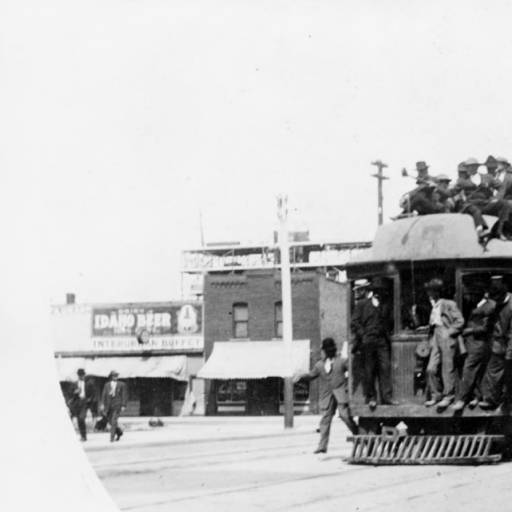
The photo is a packed Boise and Interurban car from 1910, courtesy of the Idaho State Historical Society digital collection.



 RSS Feed