The Snake River Basin Adjudication (SRBA) was an administrative and legal process that began in 1987 to determine the water rights in the Snake River Basin drainage. The best history of that battle can be found in the book A Little Dam Problem, by Jim Jones, who as a water attorney, Idaho Attorney General, and finally an Idaho Supreme Court Justice, was in it to the top of his chest waders. The Final Unified Decree for the SRBA was signed on August 25, 2014, bringing a measure of certainty to holders of Idaho water rights. I’d love to sum it up in a couple of paragraphs, but the story is too complex for this format. I recommend Jim’s 374-page book as the ultimate summation.
What I can do is give you a little peek at an early indicator that there was trouble with Idaho’s system of allocating water.
It startled me to see an article in the August 11, 1905, Idaho Republican, one of the Blackfoot Newspapers at the time. The startling headline was “Snake River Goes Dry.” Was it on the front page in a shouting font stretching all the way across beneath the banner? No, it was on page five. The headline was the same size as the body copy, albeit in bold face.
It seems that upstream canals—one of the largest of which had been built by my great grandfather—had taken every drop of water to irrigate thirsty crops in the Upper Snake River Valley. Fortunately, there was a solution at hand. The article said, “The court having issued an order to close the headgates of certain canals having later rights, the county commissioners are making diversion of the water from the canals into the river, and it is expected that it will again flow down and supply the old canals in this locality within a few days.”
Imagine the mighty Snake River so drained of its water there were only puddles for splashing fish to try to survive in. If you’ve ever seen the torrent of water coming over Shoshone Falls in a wet spring, that probably seems all but impossible. Now, imagine that happening every year below Milner Dam. You don’t have to imagine it. You can go see the dry riverbed right below the dam during the irrigation season in all but the very wettest years. It doesn’t remain dry for long. The springs below Milner begin recharging the river almost immediately.
What I can do is give you a little peek at an early indicator that there was trouble with Idaho’s system of allocating water.
It startled me to see an article in the August 11, 1905, Idaho Republican, one of the Blackfoot Newspapers at the time. The startling headline was “Snake River Goes Dry.” Was it on the front page in a shouting font stretching all the way across beneath the banner? No, it was on page five. The headline was the same size as the body copy, albeit in bold face.
It seems that upstream canals—one of the largest of which had been built by my great grandfather—had taken every drop of water to irrigate thirsty crops in the Upper Snake River Valley. Fortunately, there was a solution at hand. The article said, “The court having issued an order to close the headgates of certain canals having later rights, the county commissioners are making diversion of the water from the canals into the river, and it is expected that it will again flow down and supply the old canals in this locality within a few days.”
Imagine the mighty Snake River so drained of its water there were only puddles for splashing fish to try to survive in. If you’ve ever seen the torrent of water coming over Shoshone Falls in a wet spring, that probably seems all but impossible. Now, imagine that happening every year below Milner Dam. You don’t have to imagine it. You can go see the dry riverbed right below the dam during the irrigation season in all but the very wettest years. It doesn’t remain dry for long. The springs below Milner begin recharging the river almost immediately.
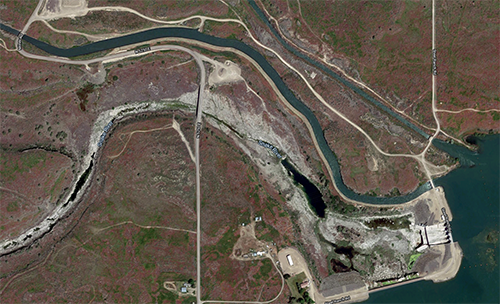
In this Google Earth satellite photo you can see the dry Snake River below the Milner Dam, with all the water diverted into canals to the north.




 RSS Feed