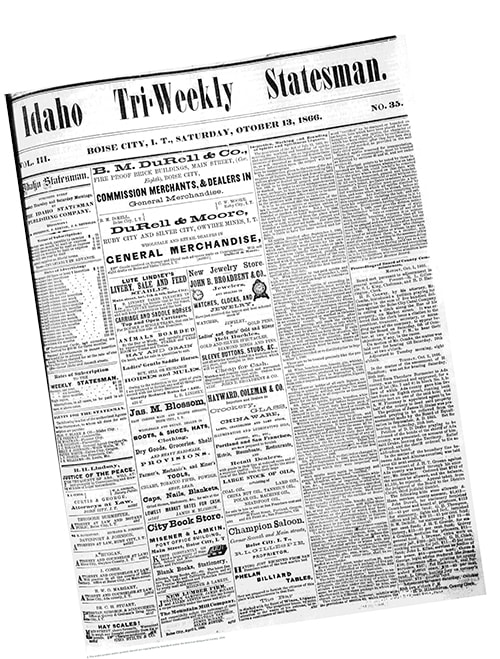
In the 1870s it was often a challenge for the staff of the Idaho Statesman and the Idaho Tri-Weekly Statesman to get the paper out. First, someone had to be found to turn the press. The single cylinder Acme press was hand operated, often by a Chinese laborer. If someone could not be found to crank the machine, it fell to the staff. Everyone from the editor on down took their turn at the wheel to keep the press running.
It was not always labor that was in short supply. The paper to feed through the press was brought in by freight teams from Kelton, Utah. Except when it wasn’t. If the newsprint failed to show, there was a scramble to find anything that would take ink. Butcher paper and grocery store paper sometimes filled in for the real thing.
The tri-weekly version of the paper had a circulation of about 1200 copies, and the weekly ran about 800 copies. That was a lot of folding. In those early days the newspapers had to be folded by hand by everyone in the office.
Charles Payton, who worked for the Statesman in the 1870s, reminisced about the early days in the December 15, 1918 edition of the paper. He remembered an irate subscriber that burst into the office one day. Payton had gotten a little ahead of the game by writing the man’s obituary. The man was on death’s door, so the paper printed it. Apparently the reportedly dead subscriber had decided not to knock on the door of death. Instead he stopped by to complain vehemently that his demise had been prematurely printed in the paper. Mark Twain, it is said, had a similar experience.
It was not always labor that was in short supply. The paper to feed through the press was brought in by freight teams from Kelton, Utah. Except when it wasn’t. If the newsprint failed to show, there was a scramble to find anything that would take ink. Butcher paper and grocery store paper sometimes filled in for the real thing.
The tri-weekly version of the paper had a circulation of about 1200 copies, and the weekly ran about 800 copies. That was a lot of folding. In those early days the newspapers had to be folded by hand by everyone in the office.
Charles Payton, who worked for the Statesman in the 1870s, reminisced about the early days in the December 15, 1918 edition of the paper. He remembered an irate subscriber that burst into the office one day. Payton had gotten a little ahead of the game by writing the man’s obituary. The man was on death’s door, so the paper printed it. Apparently the reportedly dead subscriber had decided not to knock on the door of death. Instead he stopped by to complain vehemently that his demise had been prematurely printed in the paper. Mark Twain, it is said, had a similar experience.





 RSS Feed