The first mention of Margaret Hardy in the Idaho Statesman on February 13, 1895, included the line, “Sensational developments are promised.” Oh, my.
Latah County’s first murder case would more than live up to that tease. Hardy, often called Maggie, sometimes called “Old Woman Hardy,” and once called a “black-hearted old hag” by the Statesman, would soon enough be the only woman in the Idaho State Penitentiary.
Hardy had an infamous past. She lived in Utah, Colorado, and Oregon before moving to Idaho. Each stop on her life’s journey included rumors of prostitution, theft, and the running of bordellos. In Aspen, she was charged with “despoiling” the golden hair of a seven-year-old girl by cutting it off. Years of morphine addiction caught up with her in 1893, and she was sent to the Keeley Institute in Forest Grove, Oregon. Upon release, the now “cured” woman and her husband Harvey moved to Pendleton, where a suicide attempt landed her in the state insane asylum in Salem, later infamous as the setting of the Ken Kesey novel and motion picture One Flew Over the Cuckoo’s Nest.”
After her release from that institution, the Hardys moved to Moscow, Idaho, where Maggie quickly became known for a string of minor crimes and her wicked temper.
Harvey and Maggie soon moved to Lewiston, where they acquired housemates. A prostitute named Anna Meyers, described by the press as “colored,” lived with them, along with the woman’s toddler child, Henrietta. Harvey apparently strayed with the woman, inciting Maggie’s famous temper. Explosive as that temper could be, she took a calculated course of revenge.
Maggie made a show of reconciling with Harvey because he was to play a part in her revenge. She talked Harvey into helping her adopt 2-year-old Henrietta. The girl’s mother did not initially consent, but ultimately put her X on a document granting custody to the Hardys. Only to Maggie Hardy, as it turned out. When she got custody of Henrietta, Maggie moved back to Moscow, leaving Harvey and Anna to resume their relationship.
Within days, Maggie let it be known that she planned to poison Henrietta, then kill her mother and Harvey, and finally commit suicide herself. Why no one intervened is unknown, though crossing the woman famous for her foul temper might have given some pause.
On Sunday, February 10, 1895, some terrible things happened. The way Maggie told it, she had prepared a large dose of morphine for herself, meaning to take her own life that way. She put that on the counter along with a glass filled with carbolic acid. It was not uncommon for people to commit suicide by swallowing carbolic acid, which would eat away the mouth, esophagus, and lungs. It was a hideous way to go.
Gosh, though, she got distracted from her suicide by something. When she returned to the room, she claimed she saw that Henrietta had found and swallowed the morphine, then tipped over the carbolic acid, spreading it all over her face though, oddly, not her hands. Henrietta was dead, her face and neck horribly disfigured, and one eye eaten away.
Maggie’s story was believed by approximately no one, perhaps in part because she had earlier threatened to poison the child. Mrs. Hardy was arrested for murder.
While awaiting trial, she went “suddenly stark crazy.” The sheriff figured she was angling for an insanity plea, though many who knew her thought she was never far from the mental abyss.
Hardy was charged with second-degree murder because the prosecutor thought the mandatory death sentence by hanging might cause second thoughts when considering the conviction of a woman.
The jury heard arguments for a couple of days. The defense team noted that no autopsy had been done, so charging the woman with a poisoning should not hold up. They rested their case, and the jury retired to deliberate. They did so all night, returning with a verdict of guilty the next morning. Maggie flew into a rage, condemning the jury, the judge, and every handy lawyer in the most vile terms.
Hoping for another outburst, the courtroom was packed on March 19 when she appeared for sentencing. To the disappointment of onlookers, she sat quietly while the judge sentenced her to life in prison.
In Boise Maggie Hardy, 48, made another name for herself. Officials at the prison began calling her “Mad Margaret” because of her rages. She would howl like a wolf for days. She complained of terrible stomach pains. The pains she was experiencing, according to an inmate who traveled to the prison with her, were likely caused by her attempt to commit suicide by eating glass. Doctors saw no sign that she had done so. Her next suicide attempt was real enough. She and another inmate were being kept in a small building with side-by-side cells. The neighboring prisoner smelled smoke and began to feel heat. He yelled for help. When help arrived, they found that Maggie had piled together her bed clothes and set them on fire. She was found huddled in a corner “peering through the flame and smoke, a fiendish grin on her face.”
On June 20, the superintendent of the Idaho State Insane Asylum in Blackfoot stopped by the prison to evaluate Maggie. He pronounced her “entirely sane.”
Warden John Campbell was determined to break the woman of her antics. His remedy was to build a tight, little, windowless cell for Maggie, keeping her in isolation. Seven months of such harsh treatment did little to improve Maggie’s condition, so she was shipped off to the Insane Asylum.
What happened to Maggie Hardy after that is not entirely certain. She was listed on an institution information card in Blackfoot that included the notes “Delusions of grandeur and persecution. Abnormally irritable.” Oddly, the note also included the word “dead.”
Yet, she seemed to show up one last time in the February 27, 1906, issue of the Pendelton Eastern Oregonian. The paper reported that her incinerated remains were discovered in the rubble of the burned residence where she worked as a housekeeper. When or why, she was released from the asylum is lost to history’s dust.
Thanks to Steven Branting for bringing this story to my attention and sending me a lot of information. A more detailed story about Maggie Hardy can be found in his well-written book, Wicked Lewiston.
Latah County’s first murder case would more than live up to that tease. Hardy, often called Maggie, sometimes called “Old Woman Hardy,” and once called a “black-hearted old hag” by the Statesman, would soon enough be the only woman in the Idaho State Penitentiary.
Hardy had an infamous past. She lived in Utah, Colorado, and Oregon before moving to Idaho. Each stop on her life’s journey included rumors of prostitution, theft, and the running of bordellos. In Aspen, she was charged with “despoiling” the golden hair of a seven-year-old girl by cutting it off. Years of morphine addiction caught up with her in 1893, and she was sent to the Keeley Institute in Forest Grove, Oregon. Upon release, the now “cured” woman and her husband Harvey moved to Pendleton, where a suicide attempt landed her in the state insane asylum in Salem, later infamous as the setting of the Ken Kesey novel and motion picture One Flew Over the Cuckoo’s Nest.”
After her release from that institution, the Hardys moved to Moscow, Idaho, where Maggie quickly became known for a string of minor crimes and her wicked temper.
Harvey and Maggie soon moved to Lewiston, where they acquired housemates. A prostitute named Anna Meyers, described by the press as “colored,” lived with them, along with the woman’s toddler child, Henrietta. Harvey apparently strayed with the woman, inciting Maggie’s famous temper. Explosive as that temper could be, she took a calculated course of revenge.
Maggie made a show of reconciling with Harvey because he was to play a part in her revenge. She talked Harvey into helping her adopt 2-year-old Henrietta. The girl’s mother did not initially consent, but ultimately put her X on a document granting custody to the Hardys. Only to Maggie Hardy, as it turned out. When she got custody of Henrietta, Maggie moved back to Moscow, leaving Harvey and Anna to resume their relationship.
Within days, Maggie let it be known that she planned to poison Henrietta, then kill her mother and Harvey, and finally commit suicide herself. Why no one intervened is unknown, though crossing the woman famous for her foul temper might have given some pause.
On Sunday, February 10, 1895, some terrible things happened. The way Maggie told it, she had prepared a large dose of morphine for herself, meaning to take her own life that way. She put that on the counter along with a glass filled with carbolic acid. It was not uncommon for people to commit suicide by swallowing carbolic acid, which would eat away the mouth, esophagus, and lungs. It was a hideous way to go.
Gosh, though, she got distracted from her suicide by something. When she returned to the room, she claimed she saw that Henrietta had found and swallowed the morphine, then tipped over the carbolic acid, spreading it all over her face though, oddly, not her hands. Henrietta was dead, her face and neck horribly disfigured, and one eye eaten away.
Maggie’s story was believed by approximately no one, perhaps in part because she had earlier threatened to poison the child. Mrs. Hardy was arrested for murder.
While awaiting trial, she went “suddenly stark crazy.” The sheriff figured she was angling for an insanity plea, though many who knew her thought she was never far from the mental abyss.
Hardy was charged with second-degree murder because the prosecutor thought the mandatory death sentence by hanging might cause second thoughts when considering the conviction of a woman.
The jury heard arguments for a couple of days. The defense team noted that no autopsy had been done, so charging the woman with a poisoning should not hold up. They rested their case, and the jury retired to deliberate. They did so all night, returning with a verdict of guilty the next morning. Maggie flew into a rage, condemning the jury, the judge, and every handy lawyer in the most vile terms.
Hoping for another outburst, the courtroom was packed on March 19 when she appeared for sentencing. To the disappointment of onlookers, she sat quietly while the judge sentenced her to life in prison.
In Boise Maggie Hardy, 48, made another name for herself. Officials at the prison began calling her “Mad Margaret” because of her rages. She would howl like a wolf for days. She complained of terrible stomach pains. The pains she was experiencing, according to an inmate who traveled to the prison with her, were likely caused by her attempt to commit suicide by eating glass. Doctors saw no sign that she had done so. Her next suicide attempt was real enough. She and another inmate were being kept in a small building with side-by-side cells. The neighboring prisoner smelled smoke and began to feel heat. He yelled for help. When help arrived, they found that Maggie had piled together her bed clothes and set them on fire. She was found huddled in a corner “peering through the flame and smoke, a fiendish grin on her face.”
On June 20, the superintendent of the Idaho State Insane Asylum in Blackfoot stopped by the prison to evaluate Maggie. He pronounced her “entirely sane.”
Warden John Campbell was determined to break the woman of her antics. His remedy was to build a tight, little, windowless cell for Maggie, keeping her in isolation. Seven months of such harsh treatment did little to improve Maggie’s condition, so she was shipped off to the Insane Asylum.
What happened to Maggie Hardy after that is not entirely certain. She was listed on an institution information card in Blackfoot that included the notes “Delusions of grandeur and persecution. Abnormally irritable.” Oddly, the note also included the word “dead.”
Yet, she seemed to show up one last time in the February 27, 1906, issue of the Pendelton Eastern Oregonian. The paper reported that her incinerated remains were discovered in the rubble of the burned residence where she worked as a housekeeper. When or why, she was released from the asylum is lost to history’s dust.
Thanks to Steven Branting for bringing this story to my attention and sending me a lot of information. A more detailed story about Maggie Hardy can be found in his well-written book, Wicked Lewiston.
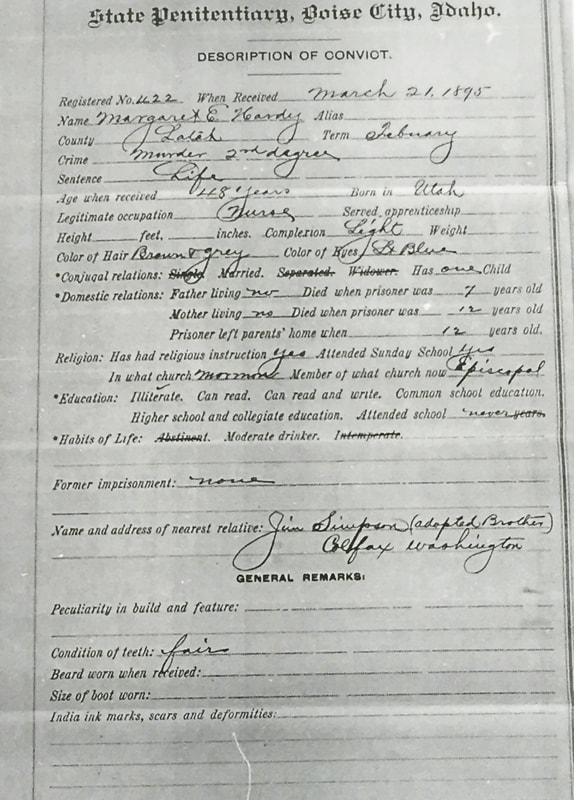
This admission sheet, courtesy of the Idaho State Historical Society Archives, tells a story. It's not necessarily an accurate one, according to Steven Branting, who has done a lot of research on Maggie Hardy. She was probably never a nurse, she wasn't born in Utah, and she was not illiterate. One chilling notation is that she had one child. Was that Henrietta she was reporting on?





 RSS Feed